
Neran (Mandi), Himachal Pradesh : In the remote hills of Himachal Pradesh, where nature often tests resilience, a teacher has rewritten the meaning of service, compassion, and responsibility.
When relentless rains in December 2025 reduced the building of Government Middle School, Neran (Gheru) to rubble, it was not just walls and classrooms that collapsed, it was the daily rhythm of childhood, learning, and hope. For the children of the village, education suddenly stood uncertain beneath an open sky.
But amid the devastation emerged a woman who refused to let dreams be buried under debris.
Narbada Devi Thakur, a Hindi teacher currently posted at PM SHRI Government Senior Secondary School, Kotli and an edskExpress Education Fellow for Himachal Pradesh, made an extraordinary decision that has now become a symbol of humanity-driven education.
Without hesitation, she opened the doors of her newly constructed private residence to the children of Neran.
Four rooms and one hall of her own home were dedicated – free of cost – so that the school could continue functioning from March 2026 onward. What could have remained a personal space became a sanctuary of learning.
At a time when many would have stepped back from responsibility, Narbada Thakur stepped forward with uncommon courage and empathy.
“I was deeply distressed to see the children’s education suffering after the school building collapsed. It was a double grief for me: first, because I received my primary education from this very school, and second, because the children’s learning was interrupted. I believe that education should never stop; with this goal in mind, I offered my home to the students,” she shared.
Her words reflect more than emotion , they reflect a lifelong commitment to the transformative power of education.
What makes this story even more powerful is that her gesture sparked a movement within the village itself.
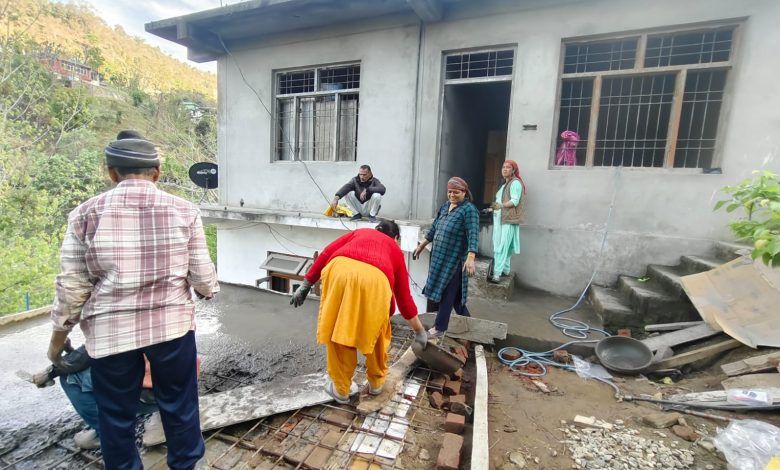
Under the leadership of SMC President Shakuntala Sharma, villagers united in collective service. Since the house lacked adequate toilet facilities for a school environment, members of the community came together through shramdan (voluntary manual labor) to construct toilets for the children.
Residents including Champa Sharma, Daksha Thakur, Upasana Sharma, Krishna Sharma, Major Gopal Thakur, Jai Singh Thakur, Nekram, and Narbada Thakur herself worked shoulder to shoulder to ensure the students had a safe and functional learning environment.
This is no longer merely a story about a collapsed school building.
It is a story about how one teacher became the bridge between disruption and hope.
It is a reminder that real nation-building does not always happen in grand halls or policy documents — sometimes, it happens quietly in villages, inside homes transformed into classrooms, through individuals who choose service over comfort.
The villagers of Neran describe Narbada Thakur not just as a teacher, but as a guardian of the future. Her act has become a living lesson for the students she serves, teaching them compassion, resilience, and community spirit far beyond textbooks.
In an age where education is often discussed in terms of infrastructure, technology, and systems, Narbada Devi Thakur has shown that the true foundation of education is humanity itself.
And perhaps that is why her story deserves to travel far beyond the hills of Himachal Pradesh, as a torchbearer of change, a role model for educators across the nation, and proof that when society stands together, no disaster can defeat learning.